Talaria, the research harness
For computational scientists whose week goes to validation instead of science.
Private beta todayOpen source December 5Hosted alpha December 5, invite only
Ideas are what moves science forward, but validation is expensive and slow: data wrangling, sysadmin, re-implementing baselines, manual checking. Talaria is a multi-agent, multi-foundation-model harness that runs that machinery. You direct it; it handles the coding, the environments, the cluster runs, and the record keeping, with the scientist in the loop and HPC as the guardrail. A mech suit for the researcher, not an auto-scientist that replaces you.
How you would use it
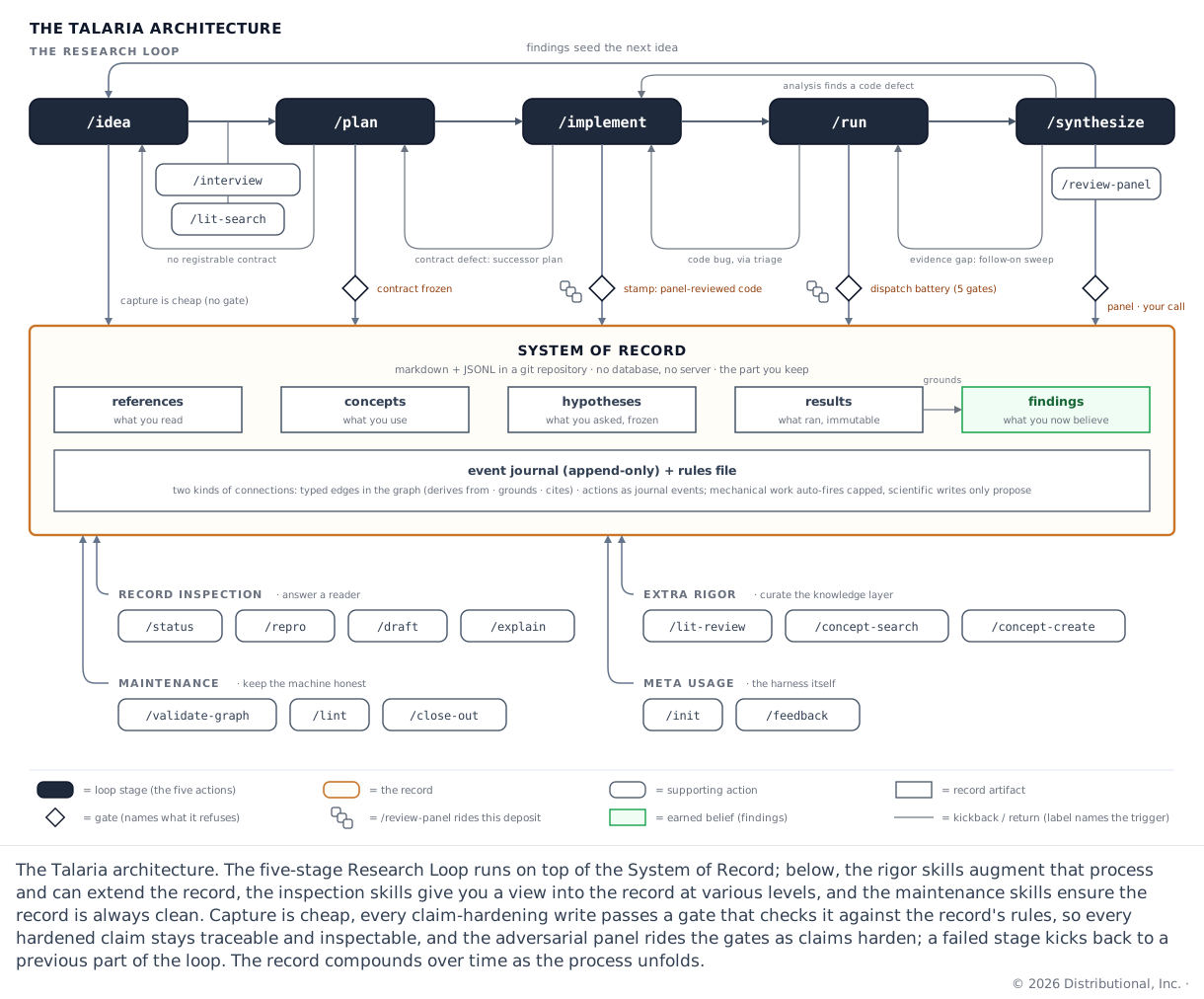
A session is a loop. You bring an idea; the harness hardens it into a pre-registered plan, builds and reviews the code, runs it on your compute, and proposes findings grounded in the results. Each stage is a skill you can read and edit.
- /idea captures the thought with its provenance. Capture is cheap; nothing is gated here.
- /plan freezes it into a pre-registered hypothesis: configurations, seeds, metrics, and what it takes to validate or refute it.
- /implement builds and reviews the experiment code.
- /run dispatches the work to your compute: a university cluster, a national-lab allocation, a cloud, or your laptop, one config block apart.
- /synthesize proposes findings from the results. A panel of isolated reviewers attacks them before they register, and the findings seed the next idea.
What you get
- A system of record: every result traces to the commit, config, seeds, environment, and cost that produced it, so an audit is a lookup and a reproduction is one command.
- Rigor that scales with the claim: a what-if costs a conversation; only the claims you want to publish pass the full depth of review and reproduction.
- Your models: a frontier coding agent drives it, the review panels fan out across the models you choose, and the record compounds whichever driver or model you swap in.
- Twenty skills in five groups: the research loop, extra rigor, record inspection, maintenance, and the harness's own upkeep.
Who it is for
- Computational physicists, applied mathematicians, and simulation-driven engineers whose experiments run on solvers and clusters: the researcher whose domain expertise no model has, and whose week still goes to work no scientist should do by hand.
- We start with PDEs, optimization, and the compute-heavy corners of applied math, on problems that validate on a single GPU first. The open core is free for everyone; the private beta starts with working research groups.
What stays yours
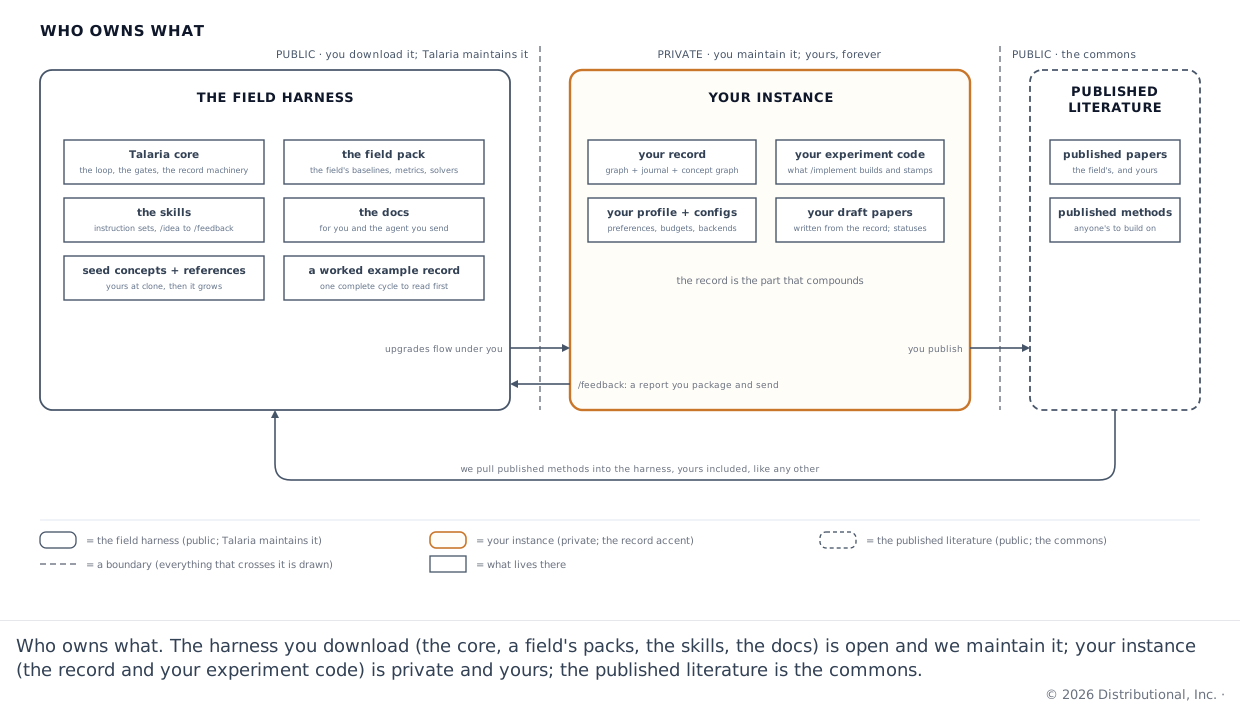
- Your instance, its record, and the models built for you are yours.
- The open core runs where your data lives and sends no telemetry.
- The hosted alpha keeps your experiment records on our infrastructure; the enterprise deployment runs in your cloud, with the data retention you set.
How to get it
- Open core, December 5: the harness from the terminal, under Apache 2.0, on your laptop, your cluster, or a cloud, driven by the frontier coding agent you bring a key for, free.
- Hosted, December 5, an invite-only alpha: sessions in a managed sandbox, the record and its DAG view, the frontier models we supply, and your own compute through the credentials you upload. The sandbox runs on our infrastructure and keeps your experiment records there; the models built for you are yours. Teams, a pack registry, and compute we provision for you follow in the beta. Includes TauOpt hosted. The open core is free for everyone; hosted compute and models are priced at cost for academic work and cost-plus otherwise.
- Enterprise, coming soon: the platform in your cloud with single sign-on, role-based access, audit logs, and the data retention you set, plus the people to run it.
Read:The architecture of the Talaria research harnessA system of record for computational scienceWhy I'm building Talaria Scientific
Get access, or get in touch
Talaria is in private beta with a small group of researchers, and TauOpt is in closed beta. For product access, use the request forms. For enterprise, partnerships, or press, use the contact page.
Talaria: the architectureTalaria: the blogTauOpt: documentation